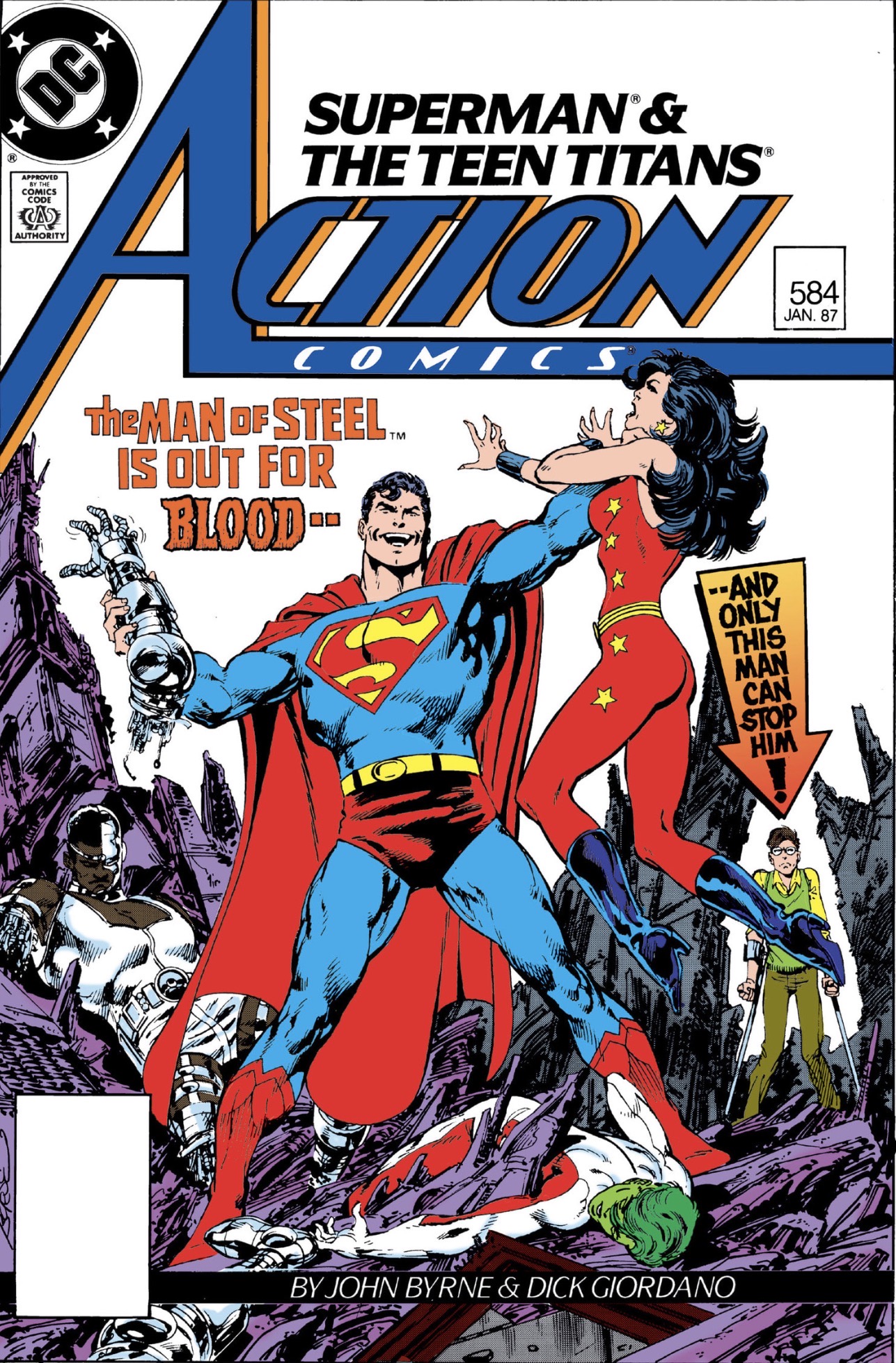

Action Comics #584
“Squatter!”
Released October 2, 1986
John Byrne – Storyteller
Dick Giordano – Embellisher
Tom Ziuko – Colorist
John Costanza – Letterer
Andy Helfer – Editor
In short: An unremarkable superhero slugfest that takes an ugly turn near the end.
Having apparently gone mad, Superman is sighted smashing up a building in downtown. As Cyborg of the New Teen Titans arrives on the scene, Superman laughs at the people scattering from the destruction, saying they can only dream of power like his. Cyborg engages him, as it becomes clear to us that Superman’s voice is way off. He’s speaking with the cringy, overwritten grandiosity of a Jack Kirby villain.

Cyborg flees and calls for backup. Alas, Changeling (later more popularly known as Beast Boy) is there to take the call. He answers with a rhyme I found hilarious the first time I read this as a kid, and that I recall my mother having to explain to me was a reference to the receptionist on MOONLIGHTING.

Fortunately, Wonder Girl (who in Post-Crisis continuity is definitely NOT a sidekick to Wonder Woman, I assure you) takes the call and sets out to help Cyborg. We get several good action pages out of it, but ultimately Changeling and Wonder Girl get defeated by Superman.
Meanwhile deaf superhero Jericho hears a news alert while mentoring some children at a hearing-impaired school. Immediately he bolts, resolving to help or die trying. He arrives as most of his friends are pretty defeated, and proves to be the most effective by using his powers to inhabit Superman’s body. Using sign language, he informs the others of a huge problem – he can’t keep Superman in check forever and the instant he leaves, the destruction begins again.
(Funny how no heroes unaffiliated with the Titans have shown up. I know at this point the Justice League is going through its own issues, but it’s kinda funny to imagine every other hero seeing the news break about “Superman gone bezerk! Titans attacking!” and going “I’m sure they’ve got this.”)
Its the Titans’ lucky day, though because a scrawny looking man (who we eventually see has forearm crutches), arrives to say that Superman isn’t responsible, “…because he’s not Superman. I’M SUPERMAN!”

Buckle up kids, because we’ve got a trademark “End of story Byrne exposition dump!”
Superman explains that through a call to Clark Kent (which in a neat bit of continuity, we saw last week in ADVENTURES #424), a scientist named David Gundersen lured Superman to his lab. The next thing Superman knew, Gundersen had activated a machine that switched their bodies. Gundersen decided not to risk what would happen to the transference if he killed Superman, so he resolved to keep him captive. Superman escaped just in time to learn about the rampage.
Conveniently, the mind transfer device is a simple on/off switch and in as much time as it takes to explain, both men are back in their proper bodies. Gundersen is none too happy about this, complaining, “Back in my own crippled, useless body! Trapped again in a world that scorns me!” Superman says that while it’s true that fate dealt Gunderson a rotten hand, “It’s not your body that makes you a cripple, Gundersen.”
“History is full of men and women who overcame incredible handicaps,” Superman further says, citing Helen Keller, Douglas Bader, and Franklin D. Roosevelt. He even points out Jericho as a positive role model. “You took my powers and became nothing more than a common hoodlum! No… it’s not your body that cripples you, Gundersen. It’s your mind.”

Where to begin with this? Let’s start with the use of the word “cripple,” which is now generally acknowledged as a slur. That wasn’t the case in 1986, so I’m giving it a pass here after acknowledging that fact. You can’t really hold old media responsible for now-outdated terms that were in common use at the time. There’s a late 90s episode of LAW & ORDER dealing with the rape of a mentally-handicapped girl that I watch with a full-body wince because it uses the word “retarded” about two dozen times. That word carries an uglier connotation today, but in 1998, it was still used in a clinical context.
So while I’m not wild to see that one word coming out of Superman’s mouth, it wasn’t done with any malice at the time.
But why on Earth did Byrne decide to make a disabled man the villain of this story? It feels so unnecessary to where the story goes. This man who’s struggled his whole life suddenly is in command of the powers of a demigod… and the first thing he decides to do is smash up some buildings for yucks and laugh at how terrified everyone is of him?
It’s especially weird considering Byrne makes sure this dude harbors a lot of resentment over being rejected by women. So if he’s now got the body of a modern Adonis who every woman would throw themselves at, why isn’t he flying off to Elle Macpherson’s latest swimsuit shoot and offering her the night of her life? (Granted, that would now be problematic in a different way, but problematic in a way that probably would have passed scrutiny in 1987.)
Or if he’s a scientist, why not explore the beauty of space? Fly to the moon? See things no man has ever seen before?
For that matter, wouldn’t it just be wonderous for a disabled person to be free of all the microaggressions a normal human doesn’t have to deal with? Couldn’t he enjoy any of that? Gundersen seems like someone who’d be happy to just have the body of Jimmy Olsen, so giving him Superman’s powers just feels like a hat on a hat if all he wants to do is go all Hulk Smash on things.
Imagine for a few minutes you have Superman’s body and powers to treat as your own. What are the first things you’re gonna do to take advantage of that, even if part of your motivation is an assumed freedom from consequences? I’m gonna guess even if you were limited to just purely selfish impulses (pick up chicks, find long lost treasure, steal a mansion from a drug lord and make it your own), none of it is gonna lead you to smashing buildings downtown.
Byrne might say that’s the point, that Gundersen does what he does because this guy is truly broken and evil. But then WHY does he have to be disabled? The villain just needs to be a normal human in order for snatching Superman’s body to be a trade-up. He could have easily been some normal able-bodied nerd who feels rejected by women and steals Superman’s body. Nothing in the plot would need to change and then we wouldn’t have the icky ableism of “Disabled people would steal your body and do crimes with it if given the chance.”
I appreciate that at least Gundersen isn’t the only person in the story with a disability. As Superman points out, Jericho is deaf and that didn’t make him any less heroic. But this also means that if the motivation for the story was to spotlight a disabled person who’s overcome their challenges, you don’t need Gunderson to be disabled. The point is already made with Jericho. I’m sure Byrne would argue that Superman’s speech is there to make clear that we shouldn’t read bad intentions into the story and to make it clear that Gundersen is a bad person regardless of the state of his body.
All true, but it was a choice to make Gundersen disabled on top of being deranged. The story didn’t gain anything from that choice and I’d like to think today there’d be a little more deliberation about doing it.
I think the impetuous for most of this story was to give us some cool action scenes of Superman vs the New Teen Titans, and so the old body swap trope was trotted out to make that happen. Even in 1986, this was something of a stock move to justify superhero fights, so perhaps Byrne was merely trying to add a different spin to the story, especially when he worked out that Jericho would save the day. I don’t think there was malice, but it definitely all adds up to a HUH?
On the final page of the story, Lex Luthor notes that Clark Kent again gets all the best Superman stories, (which is something I’ll cite as evidence against anyone justifying Clark’s unethical reporting as just being something he did to get the job.) He concludes there must be some connection between Clark Kent and Superman and resolves to find out what it is.
Clark, buddy, if you’re being blatant enough reporting on yourself that Luthor is going “This guy must have a crazy inside track,” I can’t imagine how egregiously you’re breaking journalistic ethics for five years running now. This is almost enough to make me think you’ve deserved every reaming Lois has given you about that first story.
The letters page for this issue features an essay from John Byrne that discusses his vision for ACTION as a Superman team-up book. The most interesting detail is that the Marv Wolfman/Jerry Ordway team was originally slated for ACTION and Byrne was set to launch an entirely new team-up book until it was realized “ACTION” pretty well described the kinds of team-up stories Byrne wanted to tell.







Leave a Reply