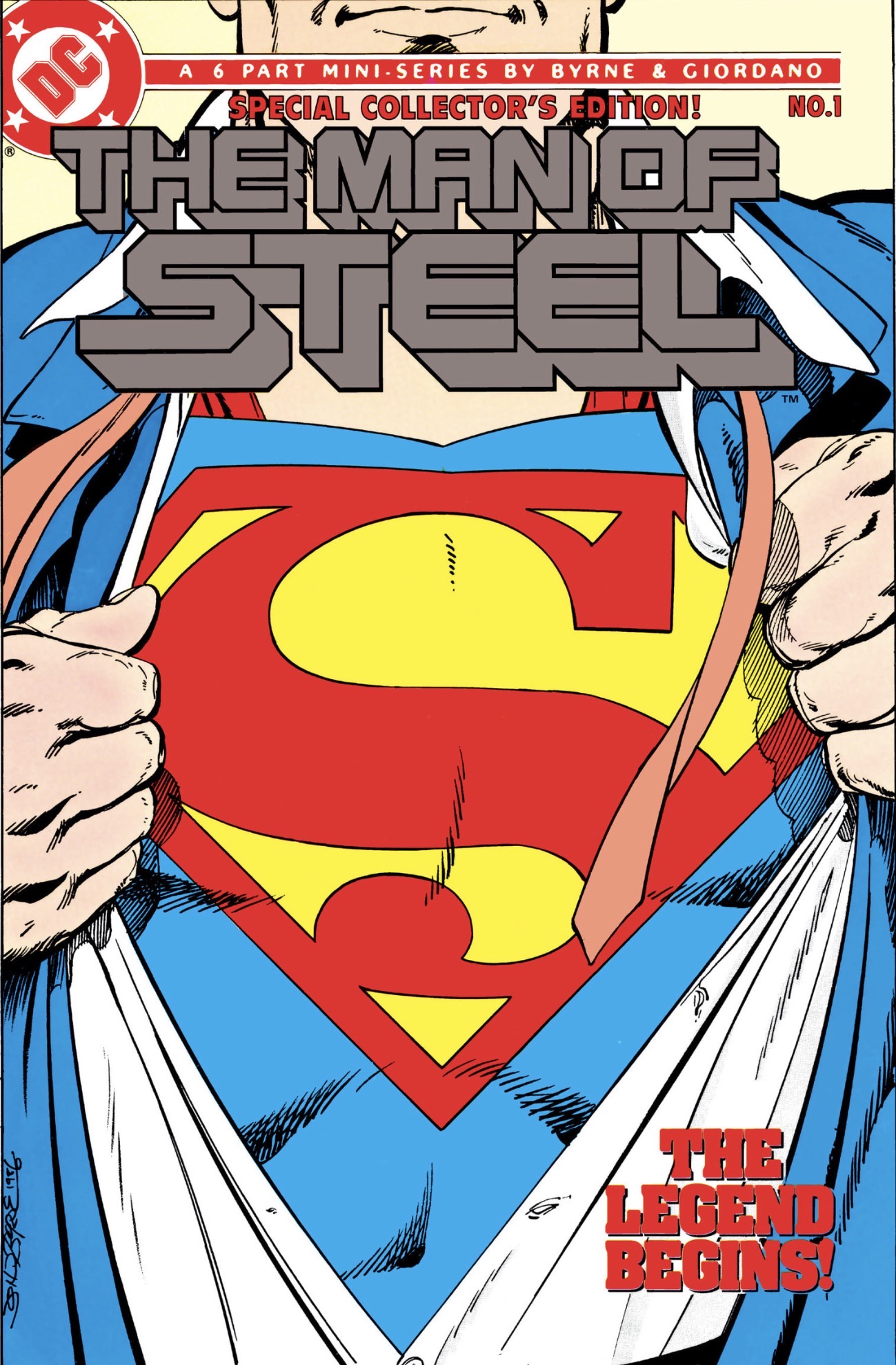

The Man of Steel #1.
Released June 19, 1986.
John Byrne – Writer & Penciller.
Dick Giordano – Inker.
Tom Ziuko – Colorist.
John Costanza – Letterer.
Andy Helfer – Editor.
This issue was my introduction to Post-Crisis Superman. My Aunt Betty gave me all six issues in the miniseries at once, so it must have been in the fall of 1986 when I actually read it. That puts me at age 6 and in first grade.
This was far from my first encounter with Superman, though I’d be hard-pressed to tell you exactly what WAS my first Superman experience. I grew up on reruns of SUPER FRIENDS. My brother and I had many SUPER POWERS figures, though in an irony, he had Superman and I had Batman. And by this point I had definitely read SUPERMAN FROM THE 30s TO THE 70s many, many times thanks to the library. ADVENTURES OF SUPERMAN was in reruns on one of my local stations by this time too
And of course, there were the Christopher Reeve movies. I had seen all three of them by this point. The first few times I saw the original Donner film on TV, my parents only let me stay up until 10pm, which got me as far as Superman and Lois’s night out together. Eventually we got a VCR and I saw the full film, as well as II and III, both of which I watched many, many times.
All of which is to say that I wasn’t coming into this at all as a Superman newbie. I had a good sense of what the earlier eras of comics looked like, enough to appreciate the fresh coat of paint that Bryne was applying.
It also didn’t hurt at all that – as I’ll point out through these first two issues especially – so much about what Bryne does harkens back to the Reeve films, both conceptually and in terms of characterization. If Christopher Reeve was your Superman, chances are John Byrne’s take is going to feel right to you.
The new Post-Crisis Superman continuity kicks off – where else? – on Krypton. Right away, Byrne gives us a Krypton that feels distinctly alien compared to the Silver Age version. The architecture, the design, the robots… none of it feels like something we’ve seen in the mythos before, and that goes for Jor-El’s formal robes.
Very quickly we notice the extremely formal tone Jor-El and Lara speak in, as we learn that Jor-El has had their unborn child removed from the “gestation chambers.” They don’t act like a familiar, loving couple on Earth. I know some fans hate the sterility of this version of Krypton, but I think it goes a long way towards making this version distinct and in heightening the contrast between Earth and Krypton.

But rather than spend this whole review litigating the Krypton choice, I’d rather save that for its own piece next week. But suffice to say, this might be my preferred version of Krypton.
In any event, we learn that there’s some kind of plague affecting the planet. Jor-El calls it a “Green Death” and says he’s learned the “terrible secret” behind it after millions have died. “A chain reaction within the core of Krypton has caused fast pressures to build within the planet’s crust. Those unnatural pressures are fusing the native elements into a new metal. A radioactive metal. It is that radiation that is killing us all, Lara.” And as if it can’t get worse, Krypton is on the verge of exploding, in perhaps as little as an hour.
It might be a hat on a hat to have a plague killing the population AND blow them up, but I get what Byrne is trying to do here… it’s trying to provide a LITTLE more rationale for why Kryptonite is deadly to Superman. To me, this verges on explaining something that doesn’t demand it, but I appreciate the effort.

Not content to let their unborn son die, Jor-El reveals his plan is to put his matrix on a “Hyper-Light Drive and launch him to a planet he’s discovered called Earth. Lara is horrified at the sight of the humans that she sees there, even as Jor-El reassures her by saying the yellow star it orbits will give their son powers to rival a god. Lara ponders that perhaps that would allow him to rule there, to shape Earth to the proper Kryptonian ways.
This line of thought is interrupted by planetary eruptions. Jor-El launches the craft, and as their world dies around them, declares his love for Lara. He says Krypton hasn’t had a place for the kinds of things he feels for her, not for centuries, but he’s come to understand his feelings by studying the habits of Earthlings.
And as Krypton dies, the craft rockets towards Earth.

We leap ahead some 18 years and find young Clark Kent as the big football star of his high school. Quite a contrast from the Waterboy we saw him as in the Donner film.

The Coach boasts to Clark’s father Jonathan how much money his son is going to make when he goes pro, but Jonathan seems troubled, especially by how much adoration Clark is getting. He tells Clark it’s time for him to tell him something he should have said a long time ago

I like Byrne exploring that Clark might use his abilities to get an unfair advantage. It reminds me a little of the exchange in the Donner movie where Clark expresses frustration at always having to hide his powers and counters his father’s accusation of showing off with “Is a bird showing off when it flies?”
Clark doesn’t know he’s an alien. He merely knows he can do things that others can’t. From his point of view, why shouldn’t he use his powers to fullest extent. Olympic Swimmer Michael Phelps’s body only generates about half the amount of lactic acid that a typical athlete’s body does. When he learned he had a genetic advantage that few others do, did he consider not being an athlete? Of course not!
In any event, Pa takes Clark out into the field and shows him something he’s hidden for a long time – the alien space ship where they found him as a baby.

In flashbacks we see the slow emergence of Clark’s powers, starting with his invulnerability saving him from an encounter with a bull at age 8. Strength and X-Ray vision followed, and then last summer Clark discovered he could fly.
Clark approaches the ship and suddenly gets weak and dizzy. We see – but he and Pa don’t – that chunk of glowing green rock is lodged in the spaceship. And as he and Pa drive off, they’re being watched by a mysterious figure.
By the time Clark returns home, he’s properly chagrined at having used his powers to make himself better than others. He decides to leave Smallville, “I have to seek out the people and places that need somebody who can do the things I do,” he says, while vowing to always do it in secret.

This is another case where Byrne’s revamp takes inspiration from the Donner movie and departs from the mythos. Pre-Crisis, Kal-El was launched from Krypton as a toddler. He had actual memories and some knowledge of Krypton. He grew up always knowing that’s where he was from and even as a teenager decided on his purpose, operating openly in public as Superboy.
The Donner film has Clark ignorant of his origins until after his father dies. (It’s ambiguous how long after… I prefer to think he at least graduated high school before leaving.) It’s not until the mysterious crystal from his ship leads him north and constructs the Fortress of Solitude does he learn about his origins from an A.I. Jor-El program/recording. No Superboy in that continuity.
I’m one of those people who prefers that Clark makes his debut as Superman, not Superboy. That again may be the influence of the Donner film on me, but I feel like him exploding onto the scene as an adult is more dramatically satisfying than him operating as a teen out of Smallville all those years. Thus, my feeling is that in terms of the right decision for the Superman books, erasing that aspect was a good move.
(I’m aware that removing Superboy came with continuity consequences. But right now those only matter if you’re reading a different title and so let’s table the discussion of that problem until the “fix” for it is addressed in the Post-Crisis mythos.)
Chapter Two begins seven years later, where we learn that Martha has kept a scrapbook of Clark’s good deeds over the years. I like this. It’s such a cute “mom” moment and it’s a good way of hinting at everything Clark’s been up to. (The man raised the Titanic!)

And in terms of a pre-Superman education, I vastly prefer this to the Donner film’s notion that Clark would spend 12 years getting an education from an A.I. Jor-El. That movie is one of my all-time favorite films, but Clark spending a dozen years locked away from the world is one of my most hated concepts in all of the Superman mythos. So he’s just entirely off the grid for 12 years? What happens when he applies to the Daily Planet and has to pass a background check?
Even worse than that, I don’t like the implication he never went home to see his mom – not on Christmas? Not on her birthday? Not on the anniversary of Jonathan’s death?!
I hate it. To paraphrase Roger Ebert, I hate, hate, hate that concept. It makes Clark into a shitty son. I much prefer Clark taking his walkabout. It also works as him exploring the world not just to do good, but to see where he might fit in the most. The guy spent 18 years living as a human and while he doesn’t have any answers about what exactly he is, it’s pretty clear he’s an alien of some kind. Him taking some time for self discovery makes a lot of sense.
It also does a lot to make him a citizen of the world. I think the degree to which Byrne focuses on Superman as an American is vastly over-stated by the critics of this era. It’s interesting to consider that his psychological reaction to being told “You’re not from Earth” was to immediately travel the world and explore other cultures, as if he’s looking for reassurance that he belongs there.
I feel like he considers himself human at heart. He didn’t know any different until he was 18 and by then a lot of his core identity would have been formed. He didn’t grow up wondering about his real parents because he always believed the Kents WERE his real parents. Finding out about another set of parents certainly would leave him with questions, but I think there are a lot of adopted kids who aren’t invested in finding their birth family – they’re content to think of the people who raised them as their real family.
Clark doesn’t know the full extent of his alien origins until later. He spends several years not knowing there ARE no living birth parents to find. No living birth planet to explore. By this point in the story, he’s 25-ish and for all he knows an alien ship could land tomorrow and claim they’ve come to take him home. I wonder if he ever considered that could happen. Or if the question mark that was his origins motivated him to put all of that aside rather than tormet himself with what-ifs?
Anyway, Jonathan sees the front page of the paper reads “MYSTERIOUS SUPERMAN SAVES SPACE PLANE” alongside a blurry photo of a flying man. The day they have dreaded is here – Clark’s exposed to the public.

Clark returns home and explains he was part of a crowd for a returning space plane, when a mid-air collision with a civilian craft imperiled both ships. Seeing no alternative, Clark sprang into action and guided the crashing space plane to the ground. Immediately he was confronted by a reporter on board – the Daily Planet’s Lois Lane.

I 100% get Byrne’s story logic in having things play out this way, but the thing holding this sequence back from being a perfect debut is that Clark’s first big reveal to the world is out of costume. Some of the majesty is lost when the big midair rescue comes from a guy in jeans and a Members Only jacket.
In staging it this way, Byrne is attempting to address two story issues at once. He wants Clark to be forced out into the open because of a visible situation where his conscience won’t let him NOT help. It instigates his change from being a barely-glimpsed guardian angel into a protector that people know exists.
He’s also trying to find a way to explain the “Superman” moniker without Clark coming off as being on a power trip by dubbing himself that. It would hard to explain why he has on an S emblem before he has that name and so the solution to both problems is a public spectacle that results in Lois dubbing him “Superman.”
Obviously in the Richard Donner film, the S was a family crest that happened to resemble an English S, which ultimately inspires Lois to call him “Superman.”
My quibbles with the street clothes aside, I like the detail both here and in the Donner movie that Lois gives him the Superman name. That wasn’t a part of the mythos at all until the movie and it’s a kick to see it brought into continuity here.
Anyway, after saving the plane and having his meet-cute with Lois, Clark doesn’t get a chance to answer her question before the crowd closes in. On impulse, he gets the hell out of there. It freaks out Clark quite a bit and now he’s not sure what to do since people know he’s out there. Pa, always with the right answer, says he knows what to do.

It turns out Pa had the idea to give Clark an entirely new identity. Taking their cue from the headline, they design an emblem to go with the name “Superman.” They also craft a new Clark Kent, putting him in Pa’s old spectacles as he slicks his hair back. The logic being that no one would assume Superman is actually living as someone else, so if he reduces his resemblance to Superman, it’s unlikely anyone will figure out the truth.

Ma and Pa both like how the costume Martha designed looks on Clark, and we see it meets with his approval too.

The issue closes with a splash page that will be homaged many, many times in the future, with Superman flying away from the Kent Farm. I’ll point these out many times over the years going forward, but rest assured you’ll be seeing plenty of callbacks to this moment. And it’s a really great shot from Byrne.

All in all as a single-issue origin, I feel like it’s a great start to the era that holds up. Byrne’s art is classic superhero style, while still being very distinctive from the Curt Swan and even Neal Adams styles that came before him.
There are some cool behind the scenes features with issue. On the inside cover is DC Executive Editor (and MAN OF STEEL inker) Dick Giordano discussing hiring John Byrne and Marv Wolfman to relaunch Superman in his weekly MEANWHILE column.

Then on the inside back cover is an essay from Byrne himself that focuses on his history with the character as a fan.

And then the back cover is a preview of issues to come.

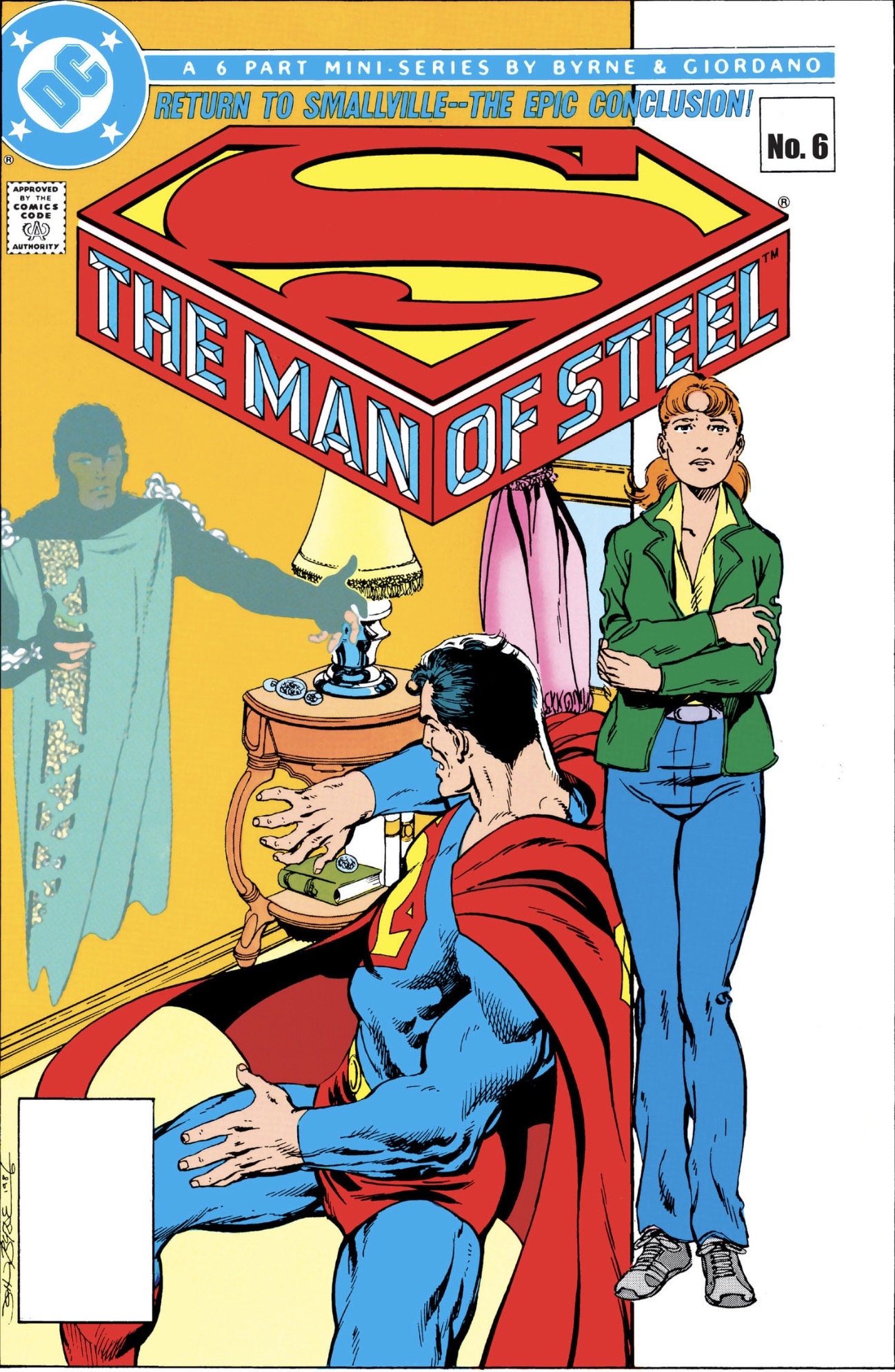
Finally, did you know that MAN OF STEEL #1 was apparently the first instance of an issue with a variant cover? This was the other cover for the issue.

Come back next week for an essay on Krypton and then MAN OF STEEL coverage resumes in two weeks!





Leave a Reply