I have a bit of a quandary when it comes to presenting the backstory of the Post-Crisis Superman. If you’re a real fan of DC Comics in this era, then you already know everything I’m going to lay out and have probably read dozens of such summaries over the years.
And if you’re not burdened with that knowledge, this era of Superman is designed as a way to get in on the ground floor. None of that history should be necessary within the stories themselves, even though occasionally it might inform why certain choices are made. From that perspective, it almost seems cruel to subject you to a history lesson that essentially ends with “But forget all that.”
Yet the completist in me feels like the material demands I set the stage for it. Thus, I shall do my best to handle it quickly.
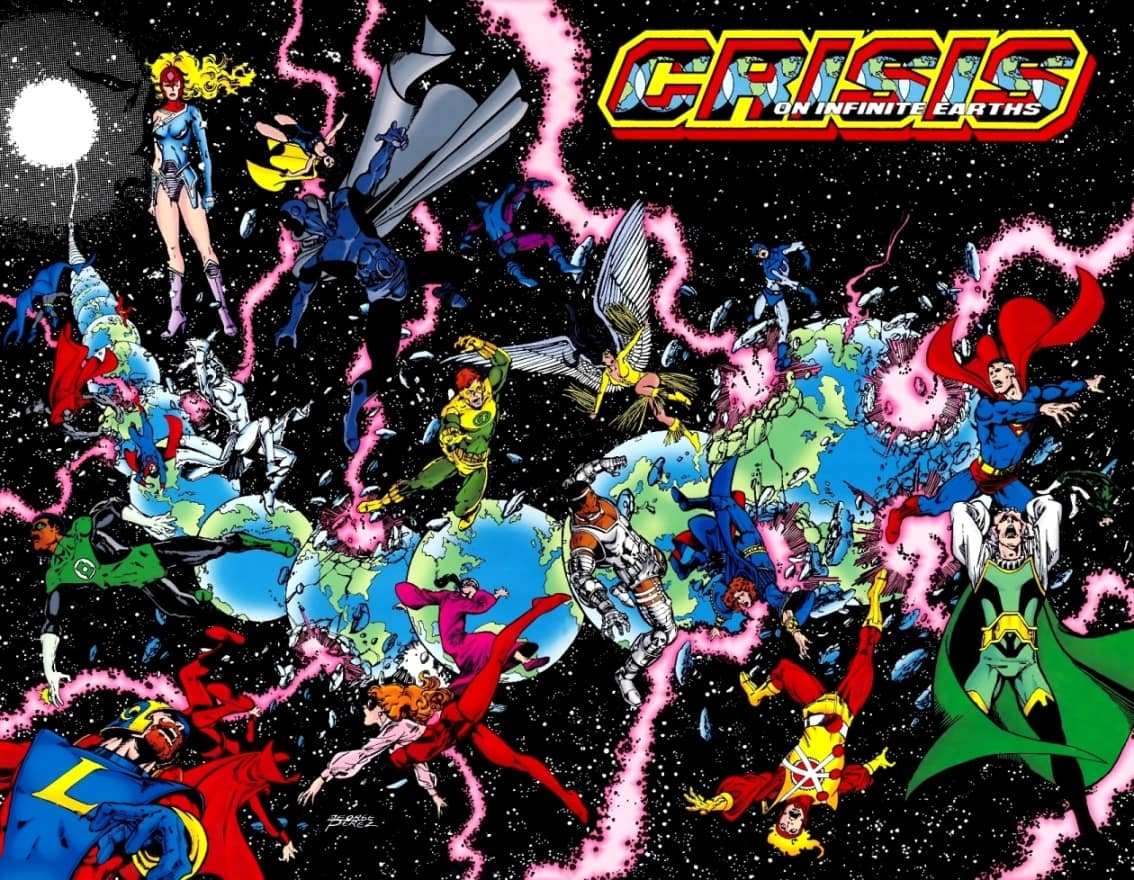
One of the most important lines of demarcation in DC Comics history is the 1985 12-issue crossover maxiseries called CRISIS ON INFINITE EARTHS. It grew out of a dual desire to celebrate DC’s 50th anniversary and simplify their universe and continuity to make it more accessible to new readers. Fortunately, thanks to SPIDER-MAN: INTO THE SPIDER-VERSE, the idea of a multiverse is now so familiar that even your mom understands it without much trouble. In 1985, DC’s multiverse had become so expansive, they were convinced it was a barrier to entry.

A little DC history lesson – Superman first appeared in 1938, Batman the following year, and Wonder Woman arrived on the scene in 1941. They had enjoyed pretty much constant publication since then. But some of their contemporaries like The Flash and Green Lantern, who were created in 1940, as well as the team the Justice Society of America, had pretty much fallen out of publication by the early 1950s. This era of heroes is usually referred to as the Golden Age.
In 1956, DC created a new character named the Flash in what is generally considered the first comic book of the Silver Age. This Flash had a completely different origin, secret identity, and costume from the original Flash. They both had super-speed powers but otherwise were entirely different. In “The Flash of Two Worlds,” this Flash crossed onto a parallel earth and encountered the Golden Age Flash, establishing that the Golden Age characters still existed on what was called Earth-2.

By this time a new Green Lantern was created, along with several other heroes who would eventually form the Justice League of America. The main heroes were on Earth-1, and it was understood that both Earths had a Superman, Batman and Wonder Woman, though at the time, there wasn’t a clear break established in the published adventures of the Earth-1 and Earth-2 incarnations of those heroes. There were eventually distinctions between the two, but most were created retroactively.
By the way, this is what is usually called a “retcon,” short for “retroactive continuity.” It means reestablishing a character’s history after the fact. The most famous retcon in history is probably the reveal that Darth Vader was Luke Skywalker’s father. That was something George Lucas didn’t have planned when he wrote the original STAR WARS. And Princess Leia turning out to be Luke’s sister is DEFINITELY a retcon, as there’s no way they would have kissed in the first two films if this was planned in advance.
In any event, plenty more Earth’s were established beyond Earth-1 and Earth-2 and DC decides they’re going to do a big story that destroys many of the universes and merges the rest so that all of their characters now exist on ONE Earth. Thus we get CRISIS ON INFINITE EARTHS, by Marv Wolfman and George Perez. It’s DC’s first line-wide crossover and would have been the first mega-crossover in history were it not for Marvel’s SECRET WARS.
By the end of CRISIS, only one Earth remains and to everyone on it, it’s as if there has always been only one earth. They’ve forgotten about the multiverse. This means that their history is different – sometimes profoundly different – than how it was experienced in the original comics.
The cleanest way to start this Post-Crisis era would probably have been to say that no one’s history still existed and wipe all the old continuity away as relaunches began. Superman and Wonder Woman both got these complete clean sweeps of their history, but NEW TEEN TITANS didn’t, owing to the fact it was one of DC’s bigger books at the time. A few other books clunk to aspects of Pre-Crisis continuity, either out of necessity or accident and in time that would have consequences.
Because DC went for the full reboot with Superman, it means that his books on their own are entirely accessible. Now, there’s a crucial change to his history that would have significant impact on another book, but within the Super-titles themselves, everything is understood without mental gymnastics.
And why did they go with a full reboot? If you look at the previous year of SUPERMAN and ACTION, those stories feel very un-stuck in time, they’re not bad and certainly Curt Swan’s art on Superman will always be iconic – but in an era where THE UNCANNY X-MEN and THE NEW TEEN TITANS were the top selling books, the Superman titles feel anything but contemporary. Strip off the issue numbers, give them to a reader broadly familiar with Superman eras, and they would be likely to peg them as being from the 60s and 70s.
In 1986, DC released both WATCHMEN and THE DARK KNIGHT RETURNS, two defining books that felt fresh, mature and edgy. By comparison, Superman was looking a little staid. Curt Swan had been drawing Superman since 1948 at that point. He wasn’t the guy to lead Superman into the eighties. For that task, DC turned to one of the hottest writer/artists of the day, John Byrne.
Byrne had made a name for himself over at Marvel on THE UNCANNY X-MEN and FANTASTIC FOUR. If DC wanted to signal that this new Post-Crisis Superman was going to be more contemporary storytelling with a more modern approach to art, there was hardly a bigger name they could have chosen at the time.
Byrne himself had been a Superman fan since childhood and he set out to craft a more back-to-basics Superman. His power levels were made more manageable, keeping him “super,” though no longer able to move entire planets or break the time barrier under his own power. These weren’t the only changes, but I’d rather take the rest as they come issue-by-issue.
The thing about John Byrne is that he’s become a divisive figure in comics. He’s a blunt, opinioned guy who speaks his mind and more than once, it’s led to him making a point in the most offensive way possible. The result is there are a few John Byrne quotes that have lived on forever and with the game of telephone that is the internet, they’ve long been divorced from their original context.
There are people who will intensely argue how Byrne destroyed Superman… and they haven’t even read the issues, they’re just parroting something they saw in an YouTube video. This also tends to happen when an offensive quote from him that was made independent of any conversation about his work is restated in the context of something he’s written. The intention being something like, “This is an offensive point of view and I’m now arguing that this offensive view is deeply buried subtext in this story so that I can cast the story in a sinister light. Thus if you defend this story, you’re defending this offensive point.”
In general, I’m not going to accept the premise of that line of thinking. The stories are gonna be judged on their own merits, not by what a secret John Byrne Decoder Ring tells us he REALLY meant.
While I’m on this line of thought, if you happen to be one of those people who thinks that “Byrne ruined Superman” or “The Triangle Era sucks and threw away everything good about the character,” you won’t find much of an audience here. If you don’t enjoy this era of Superman, I don’t really have any interest in your opinion or debating you. This doesn’t mean I’m not interested in negative criticisms of individual issues or stories – those can be fun, especially when talking about a 40-year collection of stories. But if all you have to offer is negativity, you’ve come to the wrong place.
I bring this up because the most aggressive arguments against Byrne generally repeat the same talking points and revolve around the same few stories. Yes, the Big Barda story is a low point. But we’re talking about two issues that are almost never referred to again, and the most offensive aspects of them are NEVER revisited. They’re bad, but they’re easily ignored.
Byrne’s run spans over 70 issues in a two and a half year span. That’s over six years of material for a writer on a normal book. In six year’s worth of stories, you’re gonna have some duds. That’s just how the creative process works. As long as a creator’s run is overall positive on balance, I prefer to evaluate it more based on what it gets right than what it gets wrong. Bad stories don’t negate good stories.
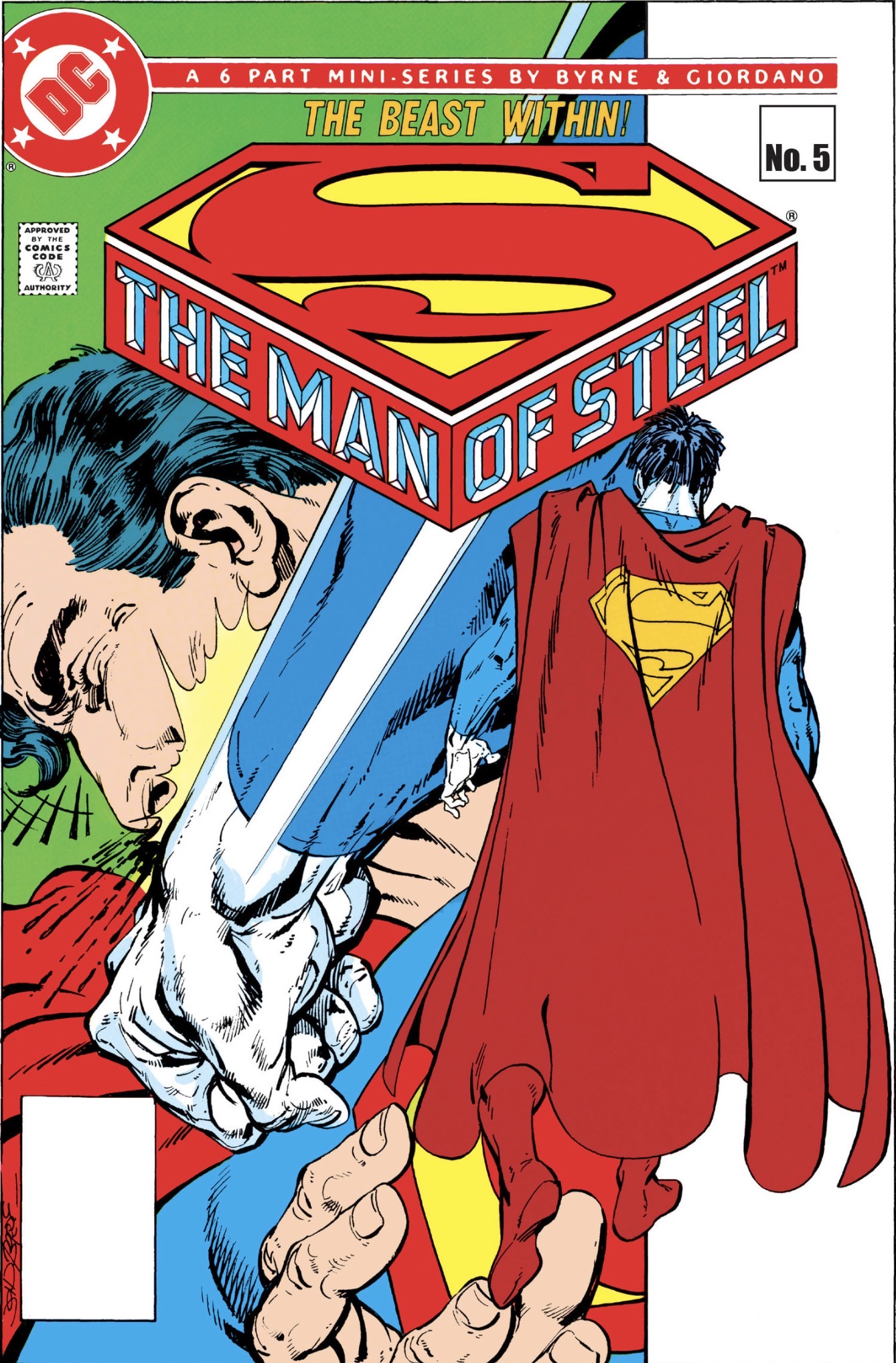
As I was gearing up for this project, I learned something I’d somehow never known in all my years as a Superman fan. I had assumed that as CRISIS ended, the MAN OF STEEL reboot was right on the heels of it. I never realized there was SEVEN months between the two! The final issue of Crisis came out on November 14, 1985 and MAN OF STEEL #1 was June 19, 1986.
And yes, during that interregnum both SUPERMAN and ACTION COMICS were in active publication. The two-part story “Whatever Happened to the Man of Tomorrow?” written by Alan Moore with pencils by Curt Swan and inks by George Perez and Kurt Schaffenberger came out less than a month earlier. SUPERMAN #423 was on May 22, 1986 and ACTION #583 was on June 5.

In a rather funny irony, this means that from a certain point of view, the first true appearance of the Post-Crisis Superman was not in MAN OF STEEL #1, but in two issues of BOOSTER GOLD published after CRISIS but before MAN OF STEEL. In issues 6 and 7, published in April and May, Booster Gold seeks the help of Superman for a mission that takes them to an alien world.

The writer and penciller of those issues? Dan Jurgens, who was just a few years away from becoming as associated with Superman as much as Curt Swan was. But we’ll get to that in due time. (And I will cover those BOOSTER GOLD issues, albeit out of sequence.)
And with the stage properly set, at the end of the week we’ll deal with the actual material, starting with MAN OF STEEL #1.





Leave a Reply